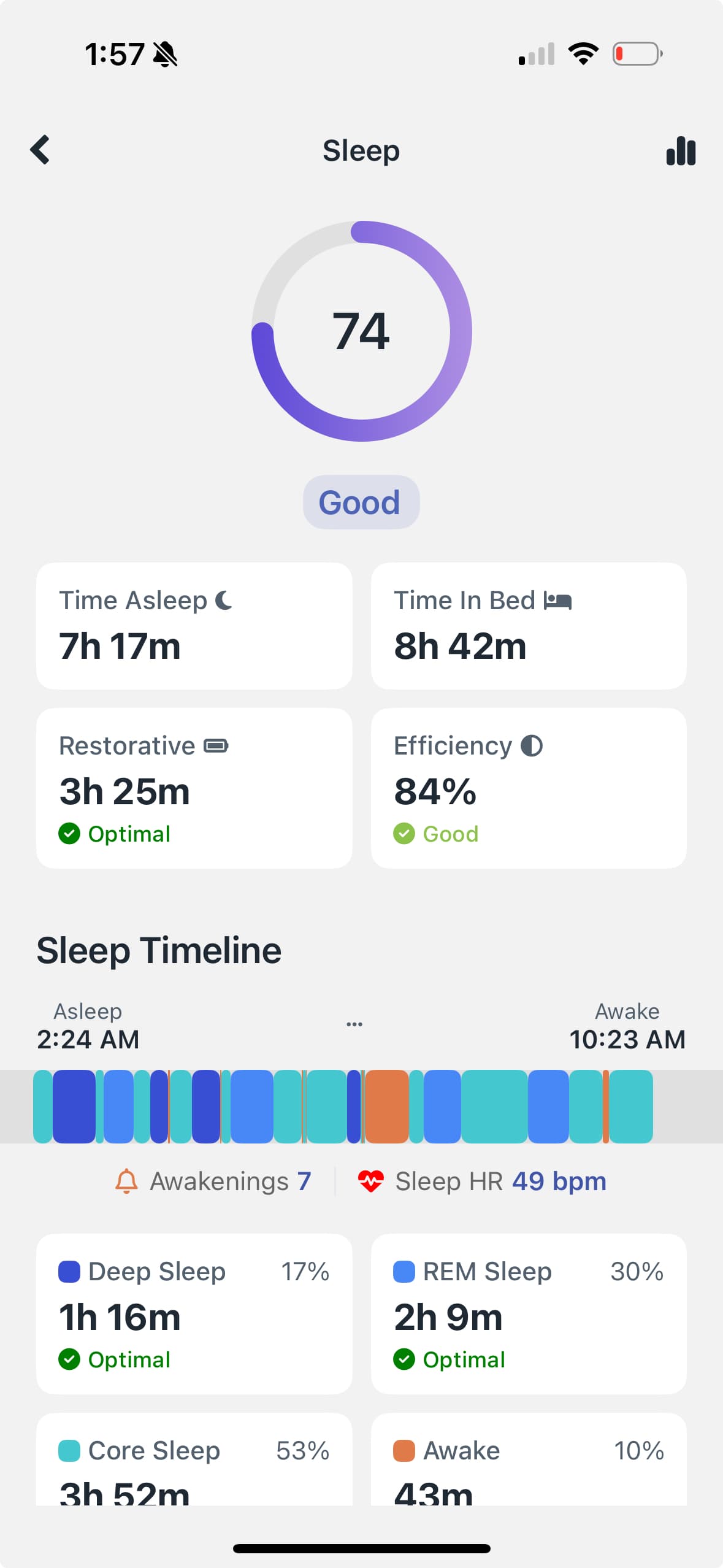
Your Apple Watch tracks your sleep every night, breaking it down into stages: Deep, REM, Core, and Awake. But what do these stages actually mean? And how much of each do you need?
This guide explains everything you need to know about sleep stages and how to use this data to improve your rest.
Understanding Sleep Tracking on Your Apple Watch
When you wear your Apple Watch to bed, it uses multiple sensors to detect your sleep stages:
- Accelerometer: Detects movement to distinguish sleep from wakefulness
- Heart rate sensor: Monitors heart rate variations that correlate with different sleep stages
- Respiratory monitoring: Tracks breathing pattern changes throughout the night
Research shows consumer devices like Apple Watch achieve more than 90% agreement with clinical polysomnography (the gold standard sleep study) for distinguishing sleep from wakefulness. However, they're less precise for identifying specific sleep stages—about 62% accuracy for deep sleep detection, for example.
That said, the trends over time are still valuable. Even if any single night's data isn't perfectly accurate, patterns across weeks and months reveal meaningful insights about your sleep health.
The Four Sleep Stages Your Apple Watch Tracks
1. Deep Sleep (Slow-Wave Sleep / N3)
Deep sleep is your body's restoration period. This is when the real physical recovery happens.
What happens during deep sleep:
- Human growth hormone is released, facilitating tissue growth and repair
- Your immune system produces cytokines to fight infection and inflammation
- Your breathing slows, heart rate drops, and muscles fully relax
- Brain waves slow to their lowest frequency (delta waves)
How much you need: Adults typically need 1.5-2 hours of deep sleep per night. The average Apple Watch user gets about 49 minutes (roughly 13% of total sleep time).
Deep sleep is hardest to wake from. If you've ever been jolted awake and felt completely disoriented, you were probably in deep sleep.
2. REM Sleep (Rapid Eye Movement)
REM sleep is your brain's processing time. While your body rests, your mind is highly active.
What happens during REM:
- Your brain consolidates memories and processes information
- Problem-solving abilities are enhanced
- Emotional experiences are processed and regulated
- Most vivid dreaming occurs
- Your eyes move rapidly (hence the name)
- Your body experiences temporary muscle paralysis (to prevent acting out dreams)
How much you need: REM should comprise about 20-25% of total sleep time—roughly 90-120 minutes for an 8-hour night.
REM sleep tends to increase in later sleep cycles, which is one reason why cutting sleep short is particularly harmful—you're often sacrificing your longest REM periods.
3. Core Sleep (Light Sleep / N1-N2)
Core sleep is often dismissed as "just light sleep," but it's essential. It comprises the majority of your night and serves as the foundation that enables deep and REM sleep.
What happens during core sleep:
- Your body transitions from wakefulness to sleep (N1)
- Heart rate and breathing begin to regulate
- Body temperature drops
- Brain produces sleep spindles and K-complexes (patterns associated with memory consolidation)
- You're more easily awakened than in deep sleep
How much you need: Core sleep typically comprises about 50-60% of total sleep time. This is normal and healthy—don't worry if it seems like a lot.
4. Awake Time
Brief awakenings throughout the night are completely normal. Most people don't remember them.
What's normal:
- 5-10% of the night spent briefly awake
- Brief awakenings between sleep cycles
- Occasional position changes
What's concerning:
- Prolonged awakenings (lying awake for 20+ minutes)
- Frequent awakenings that you remember
- Difficulty returning to sleep
If your Apple Watch shows significant awake time, consider factors like caffeine, alcohol, stress, or sleep environment issues.
The Science Behind Sleep Stage Tracking
Your body cycles through these stages multiple times per night, typically in 90-minute cycles. A healthy night looks something like:
Early night: More deep sleep, shorter REM periods Late night: Less deep sleep, longer REM periods
This is why sleep timing matters. If you normally sleep 11 PM - 7 AM but shift to 2 AM - 10 AM, you might get the same total hours but a different distribution of stages—potentially less deep sleep due to circadian rhythm effects.
How Sleep Stages Change Throughout Life
Your sleep architecture evolves as you age:
Infants and children: Much more total sleep and extended deep sleep periods. This supports rapid growth and development.
Teenagers: Circadian rhythms shift later (explaining the "night owl" tendency). Deep sleep begins declining.
Adults: Sleep patterns stabilize but deep sleep continues gradually decreasing—about 2% less per decade.
Older adults: Significantly less deep sleep, more fragmented sleep, more time awake during the night. This is normal aging, though good sleep hygiene can minimize the impact.
Optimizing Your Sleep Stages
You can't directly control which sleep stage you're in, but you can create conditions that promote better sleep architecture:
For More Deep Sleep:
- Exercise regularly (but not too close to bedtime)
- Keep your bedroom cool (65-68°F / 18-20°C)
- Avoid alcohol—it may help you fall asleep but suppresses deep sleep
- Maintain consistent sleep timing
For More REM Sleep:
- Get enough total sleep—REM increases in later cycles
- Avoid alcohol and cannabis, both of which suppress REM
- Manage stress and anxiety
- Don't use an alarm if possible—you're often interrupting REM in the morning
For Better Sleep Efficiency Overall:
- Maintain a consistent sleep schedule, even on weekends
- Create an optimal sleep environment (dark, quiet, cool)
- Limit screen time before bed (blue light suppresses melatonin)
- Avoid caffeine after early afternoon
- Develop a relaxing pre-bed routine
Understanding Your Zolt Sleep Scores
In Zolt, we analyze your sleep stage data to provide actionable insights:
- Sleep Score: An overall assessment of your night's sleep quality
- Stage Distribution: How your time was split between deep, REM, core, and awake
- Trends Over Time: How your sleep architecture is changing week over week
- Recovery Impact: How your sleep stages affect your next-day recovery score
Rather than obsessing over any single night, focus on trends. Are you consistently getting enough deep sleep? Is your REM percentage healthy? Are your awake periods increasing?
Frequently Asked Questions
How accurate is Apple Watch sleep tracking?
Apple Watch is good at detecting whether you're asleep or awake (90%+ accuracy) but less precise at identifying specific stages (around 62% for deep sleep). Use it for trends and patterns rather than precise measurements.
Why does my deep sleep seem low?
Average deep sleep for Apple Watch users is about 49 minutes—lower than the often-cited 1.5-2 hour recommendation. This may reflect measurement differences between consumer devices and clinical studies. Focus on whether you feel rested rather than hitting a specific number.
Why are there gaps in my sleep tracking?
This usually happens when your watch loses skin contact or battery drops too low. Keep your watch charged above 30% and ensure a secure (but comfortable) fit.
Can I improve my deep sleep percentage?
Exercise, cooler bedroom temperatures, consistent sleep timing, and avoiding alcohol can all help. But genetics also play a role—some people naturally get more deep sleep than others.
The Bottom Line
Sleep stages aren't just interesting data—they reflect what your body and brain are doing to restore and prepare you for the next day. Deep sleep repairs your body. REM processes your mind. Core sleep ties it all together.
While you can't directly control your sleep stages, understanding them helps you make better choices about sleep timing, environment, and habits. Track your trends over time, experiment with improvements, and pay attention to how you feel—that's ultimately what matters most.