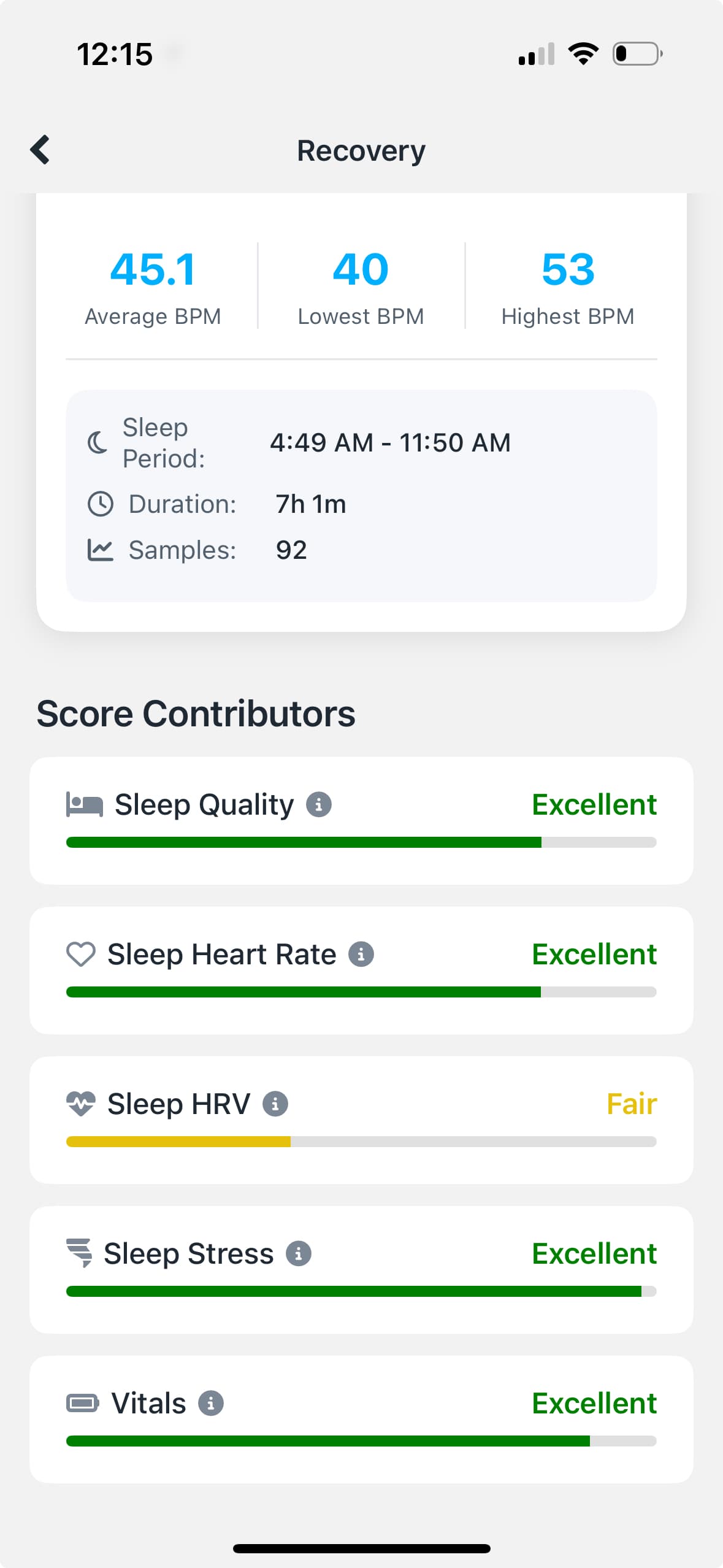
Zolt's Recovery Score represents a personalized daily assessment of your body's recuperation status and readiness for upcoming physical and cognitive demands. The system analyzes physiological markers captured during sleep to evaluate your capacity for performance across different domains.
Understanding Your Recovery Score
| Rating | Score Range | What It Means | |--------|-------------|---------------| | Excellent | 75-100 | Your body is well-recovered and ready for optimal performance | | Good | 50-75 | Your recovery is adequate for most activities | | Fair | 25-50 | Your body shows signs of incomplete recovery | | Poor / Needs Work | 0-25 | Your body is showing significant signs of stress or incomplete recovery |
Note: The app requires 30-60 days for complete personalization to your individual physiology.
What Goes Into Your Recovery Score
The system examines four primary physiological components:
- Sleep Quality – Overall sleep assessment from the prior night, factoring in duration, efficiency, and stage distribution
- Resting Heart Rate (RHR) – Lowest sustained heart rate during sleep, compared against your personal baseline
- Heart Rate Variability (HRV) – Time variation between consecutive heartbeats, reflecting autonomic nervous system balance
- Respiratory Rate – Breathing frequency during sleep, indicating relaxation level
Why Each Component Matters
Sleep Quality
Foundation of recovery. Quality sleep enables tissue repair, memory consolidation, and energy restoration. When sleep quality diminishes, other metrics become increasingly critical for assessing overall recovery. Research demonstrates that sleep is an essential body function for exercise recovery, and insufficient sleep negatively impacts both physical performance and training recovery.
Heart Rate Variability
Among the most significant recovery indicators. Elevated HRV relative to your baseline typically suggests superior recovery and stress resilience. Reduced HRV may indicate your body is working harder to recover or experiencing stress. Research shows HRV functions as a non-invasive method to assess autonomic nervous system modulation and represents a valid indicator of sympathicovagal balance.
Resting Heart Rate
Elevated RHR relative to baseline frequently signals incomplete recovery, potential infection, or excessive tiredness. Stable or lower RHR suggests successful recovery. Studies confirm that better-trained athletes typically have lower resting heart rates and that monitoring changes in RHR can help track recovery status.
Respiratory Rate
Elevated respiratory rate during sleep may suggest stress or incomplete recovery, while consistent lower rates typically indicate successful recovery. Research confirms that respiratory rate naturally decreases during sleep and that monitoring respiratory patterns during sleep can provide insights into recovery state.
How Zolt Calculates Your Recovery Score
Your Recovery Score uses personalized comparison against your own historical baseline rather than population-wide averages. This personalization strengthens over time, progressively improving accuracy.
When multiple metrics reveal stress or incomplete recovery indicators, the algorithm automatically prioritizes these signals, enabling more precise detection of recovery complications.
The Morning Check-In Feature
The Morning Check-In serves as a critical personalization mechanism. Each morning, record subjective wellness using this quick assessment tool. This provides two important functions:
- Correlation Analysis – Zolt compares your reported feelings with objective physiological data, clarifying relationships between perception and bodily function
- Personalized Insights – Over time, the system identifies patterns linking your reported state with recovery metrics, delivering increasingly tailored guidance
Usage Tips:
- Complete your check-in at consistent times daily
- Provide honest assessments, even if contradicting your score
- Track correlations between feelings and metrics
Meaningful pattern correlation typically emerges after 2-3 weeks of consistent engagement.
Actionable Insights Based on Your Score
Excellent (75-100)
- Ideal for: High-intensity workouts, mentally demanding activities, skill acquisition
- Recommended actions: Capitalize on superior recovery through physical or mental challenges
- Notes: Document factors contributing to this outcome for future replication
Good (50-75)
- Ideal for: Standard workouts, typical work responsibilities, moderate cognitive tasks
- Recommended actions: Maintain regular routine while monitoring personal responses
- Notes: Scores typically cluster in this range or higher with proper self-care
Fair (25-50)
- Ideal for: Regular workouts with heightened awareness
- Recommended actions: Emphasize proper warm-ups, form, and stress reduction techniques
- Notes: Performance may not reach peak levels; patterns help explain variations
Poor (0-25)
- Ideal for: Scheduled workouts requiring enhanced recovery attention
- Recommended actions: Prioritize nutrition and hydration; minimize caffeine and alcohol
- Notes: Performance deficits during exercise become explicable; extended poor scores (3+ consecutive days) warrant investigation
Stress Detection
The Recovery Score incorporates sophisticated stress identification that recognizes when physiological metrics significantly deviate from your established patterns. Upon stress detection, the system adjusts scoring accordingly and identifies which metrics display stress indicators.
Tips for Improving Your Recovery Score
- Maintain consistent sleep schedules – Establish similar bedtimes and wake times daily
- Manage training volume – Balance demanding workouts with adequate recovery periods
- Ensure adequate hydration – Dehydration impairs HRV and recovery capability
- Restrict alcohol before sleep – Alcohol disrupts sleep quality and HRV significantly
- Practice stress reduction – Deep breathing, meditation, or gentle movement enhance HRV and recovery
- Monitor long-term patterns – Identify behavioral habits affecting recovery trajectory
Important: Day-to-day fluctuations are normal. The Recovery Score proves most valuable when tracking patterns over extended periods and understanding how behavioral choices affect recuperation.
Frequently Asked Questions
Why did my score drop despite 8 hours of sleep?
Sleep duration represents only one recovery factor. Lower scores may result from diminished sleep quality, elevated resting heart rate, or reduced HRV. Late meals, alcohol consumption, illness, or psychological stress can compromise these metrics independently of sleep duration.
How quickly do lifestyle changes improve scores?
Most users notice improvements within 3-5 days of implementing positive changes like consistent sleep timing, proper hydration, and stress management. However, significant trend emergence typically requires 2-3 weeks of sustained habits.
Can I exercise with a low recovery score?
Absolutely. A low score provides performance context rather than prohibition. You might observe suboptimal performance or require increased form focus. The score functions as informational, not restrictive.
Why do my scores fluctuate dramatically day-to-day?
Daily variations reflect your body's dynamic responses to various stressors. Emphasize weekly trends over daily measurements. Extreme swings (40+ points) warrant tracking potential contributors like caffeine intake, meal timing, or work stress.
What matters more—actual score or trend?
Both offer value, though trends typically provide superior actionable intelligence than individual daily scores. Examine weekly and monthly patterns to identify factors consistently impacting recovery positively or negatively.