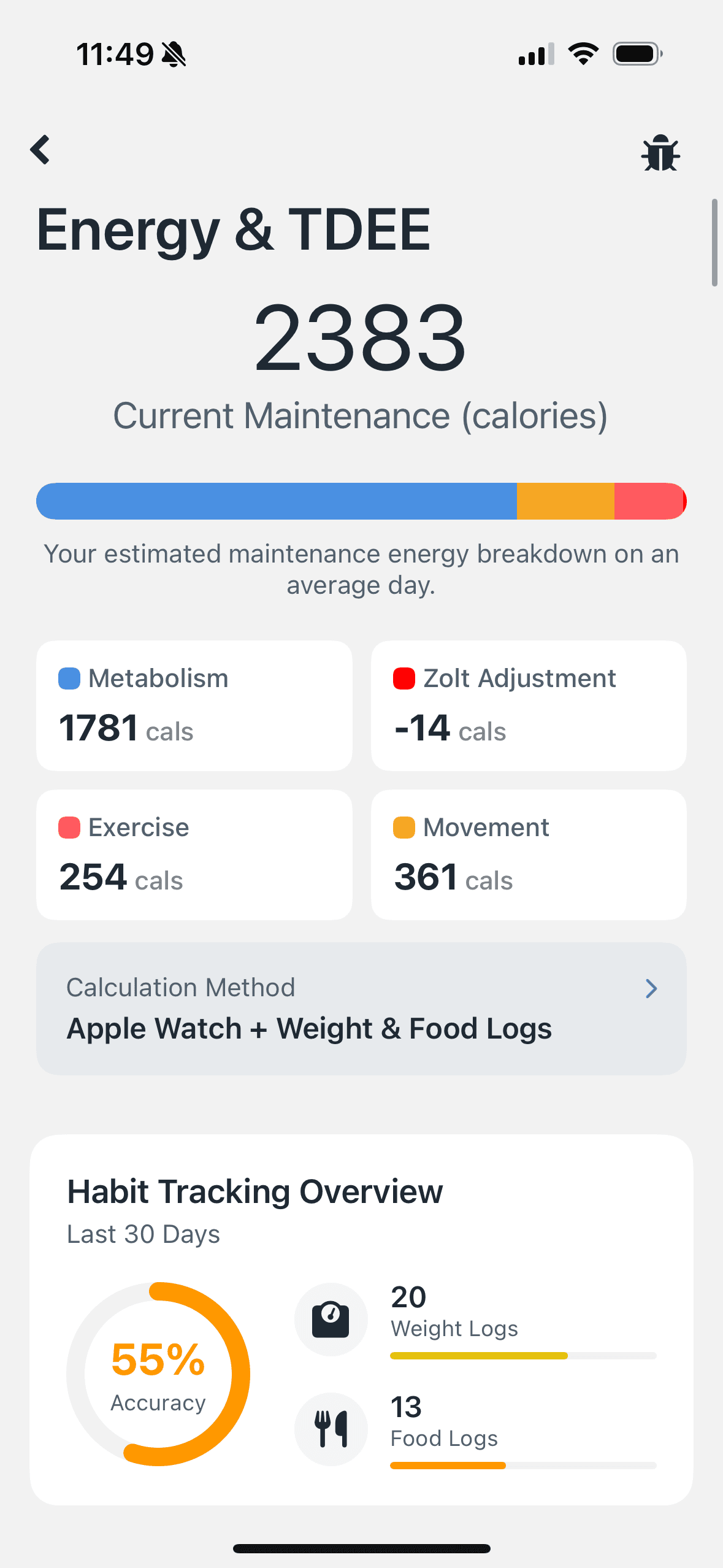
You've probably used an online TDEE calculator before. Plugged in your height, weight, age, and guessed at your activity level. Got a number. Started eating that many calories. And then... nothing happened. Or worse, you gained weight.
The problem isn't you. It's that traditional TDEE calculators are just guessing. Adaptive TDEE is different—it figures out your body's exact maintenance calories based on what's actually happening, not what some formula thinks should happen.
What Is Adaptive TDEE?
Adaptive TDEE is a dynamic method of calculating your Total Daily Energy Expenditure that adjusts based on your real weight changes and food intake over time.
Instead of relying on a formula that estimates your calorie burn, adaptive TDEE watches what actually happens to your body. If you eat 1,800 calories a day for a few weeks and your weight stays the same, that's your TDEE. Simple as that.
The "adaptive" part means it keeps updating. If your metabolism slows down during a diet (which it does), your adaptive TDEE catches that. If you start moving more and burning more calories, it catches that too.
How Adaptive TDEE Works
The core principle is straightforward: your weight change tells us how many calories you're actually burning.
Here's the process:
1. Data Collection
You track your food intake and body weight consistently over 3-4 weeks. The more consistent, the better the data.
2. Trend Analysis
Daily weight fluctuates a lot—water retention, sodium, digestion, etc. Good adaptive TDEE algorithms filter out this noise to find your true weight trend.
3. Automatic Adjustment
Based on your actual results, the system recalculates your TDEE. Losing weight faster than expected? Your TDEE might be higher than initially thought. Not losing at all? It's probably lower.
In Zolt, we also integrate your sleep quality, recovery metrics, and activity levels to give you a complete picture—not just the raw math.
Why Traditional TDEE Calculators Fall Short
Traditional formulas like Harris-Benedict, Mifflin-St Jeor, and Katch-McArdle have been around for decades. They're not useless, but they have serious limitations:
Metabolic Individuality
Two people with identical height, weight, age, and activity level can have TDEEs that differ by 200-400 calories daily. Genetics, muscle mass, hormones, and gut bacteria all play a role that formulas can't capture.
Adaptive Thermogenesis
When you diet, your metabolism slows down. This is called metabolic adaptation, and it can reduce your TDEE by 15-25% during prolonged calorie restriction. Static formulas have no way to account for this.
Activity Level Guesswork
Be honest: when you select "moderately active" on a calculator, do you really know what that means? Most people either overestimate or underestimate their activity level, leading to calorie targets that are way off.
Measurement Errors
Even if you track diligently, there are errors in food logging and weight measurement. Static calculations don't compensate for these imperfections—adaptive methods do, because they look at trends over time.
The Science Behind Adaptive TDEE
The foundation is basic physics: calories in versus calories out determines weight change.
One pound of body fat contains approximately 3,500 calories. So theoretically, a 500-calorie daily deficit should produce about one pound of fat loss per week.
But here's where it gets interesting. Research shows that metabolic adaptation can reduce your energy expenditure by 15-25% during prolonged calorie restriction. Studies by Rosenbaum & Leibel (2010) and the famous Minnesota Starvation Experiment demonstrated that your body actively fights weight loss by burning fewer calories.
This is why static TDEE calculators fail so many people. They assume your metabolism stays constant, but it doesn't.
Adaptive TDEE systems track what's actually happening. Research by Martins et al. (2020) shows that adaptive methods incorporating real-world feedback consistently outperform static calculations for long-term weight management.
Benefits of Using Adaptive TDEE
Precision Targeting
Get calorie targets based on your metabolism, not a population average.
Real-Time Adjustments
Your TDEE updates automatically as your body changes during weight loss or muscle-building phases.
Reduced Plateaus
By accurately tracking metabolic adaptation, you can adjust before you hit a wall.
Better Adherence
When you trust your calorie target, you're less likely to make drastic changes during temporary slowdowns.
Long-Term Success
Knowing your actual calorie needs makes maintenance sustainable. No more yo-yo dieting.
Holistic Integration
In Zolt, we go beyond basic calculations. We incorporate sleep consistency, sleep debt, and recovery status to give you coaching that considers your whole life—not just calories.
How to Get Your Adaptive TDEE
Option 1: Use Zolt (Easiest)
Zolt automatically calculates your adaptive TDEE and adjusts your macro targets. Just log your food and weigh in regularly—the app handles the rest.
Features include:
- AI-powered food logging with voice recognition and barcode scanning
- Automatic weight syncing from Apple Health or Google Fit
- Real-time TDEE updates with confidence indicators
- Personalized coaching based on sleep and recovery data
Option 2: Use a Spreadsheet
If you prefer manual tracking, you can use the nSuns adaptive TDEE spreadsheet or our web calculator. You'll need to:
- Log your weight every morning (same conditions)
- Track your total daily calorie intake accurately
- Wait 3-4 weeks for the data to stabilize
- Calculate your TDEE from the weight trend vs. calorie intake
The spreadsheet method works, but it requires discipline and manual calculation. Most people find it tedious after a few weeks.
Common Adaptive TDEE Mistakes
Inconsistent Logging
Sporadic tracking creates data gaps that reduce accuracy. You don't need to be perfect, but you need to be consistent.
Too Short Timeframes
One to two weeks of data isn't enough. Daily fluctuations can mask your true trend. Give it at least 3-4 weeks before trusting the number.
Ignoring External Factors
Illness, stress, medication changes, and hormonal fluctuations can temporarily affect your weight and TDEE. Don't panic over short-term changes—look at the bigger picture.
Changing Too Many Variables
If you're trying to dial in your TDEE, don't also start a new workout program, change your sleep schedule, and switch to a new diet all at once. Keep things stable while you collect data.
Why Zolt Is the Best Adaptive TDEE Solution
We built Zolt because we were frustrated with the same problems you're facing. Spreadsheets are tedious. Apps that just count calories miss the bigger picture.
Zolt combines:
Adaptive TDEE Core: Our algorithm uses your weight changes and calorie intake to calculate your true maintenance calories with exceptional accuracy.
Personalized Coaching: We don't just give you a number. We consider your sleep quality, recovery status, training load, and daily patterns to help you actually hit your goals.
Effortless Tracking: AI-powered food logging, automatic health data syncing, and smart reminders make tracking something you can actually stick with.
The result? Sustainable progress based on what your body is actually doing, not what a formula guesses it should do.
The Future of Personalized Nutrition
Adaptive TDEE represents a fundamental shift: from generic formulas to individualized nutrition based on your personal data.
As wearable technology and AI continue to advance, expect even more sophisticated systems. Emerging research on metabolic flexibility, circadian rhythm impacts on metabolism, and personalized nutrition genomics will shape the next generation of tools.
We're already incorporating some of this into Zolt—like how your sleep timing affects your metabolism, and how your recovery status should influence your calorie targets.
The future isn't about following a one-size-fits-all diet. It's about understanding your unique body and fueling it accordingly.
Ready to find out what your body is actually burning? Try the free adaptive TDEE calculator or download Zolt to get started with automatic tracking.