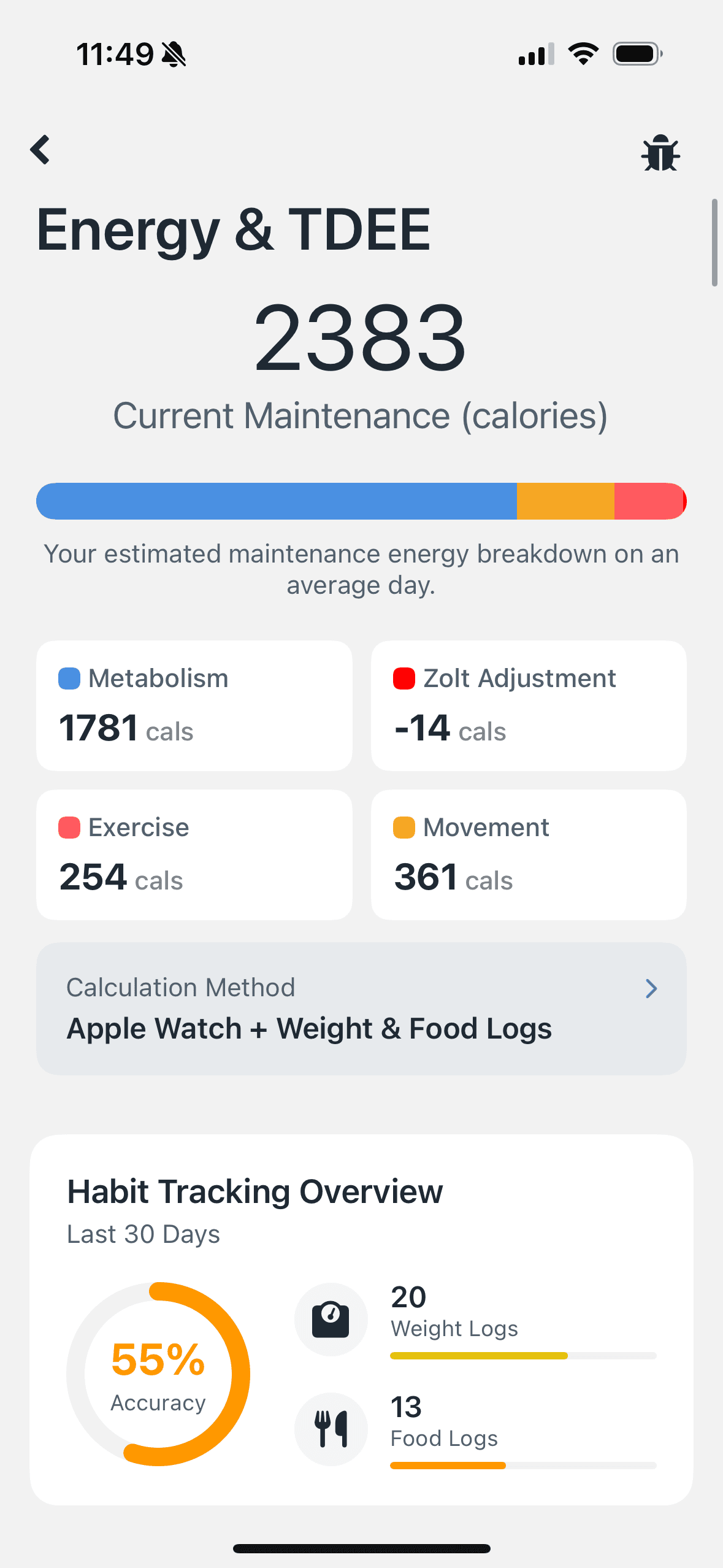
Our bodies constantly burn energy, and understanding consumption is essential for fitness goals. Two key measurements—Basal Metabolic Rate (BMR) and Total Daily Energy Expenditure (TDEE)—show personal energy balance.
Think of it like a car:
- BMR = fuel burned idling at a stoplight (basic bodily functions)
- TDEE = total fuel for a day's driving (BMR plus all movement and exercise)
What is BMR (Basal Metabolic Rate)?
BMR represents your body's energy requirement for existing. It's the calories you'd burn staying in bed all day without movement—your body's "idle mode" maintaining vital organ function.
Factors Influencing BMR
- Age: Decreases with age as metabolism slows
- Gender: Men typically have higher BMR than women (testosterone/muscle mass)
- Height & Weight: Larger bodies require more maintenance energy
- Body Composition: Muscle tissue burns more calories than fat at rest
Measurement
- Gold standard: Indirect calorimetry (lab-based breath analysis)
- Common formulas: Harris-Benedict and Mifflin-St Jeor equations
Typical BMR Ranges
- Adult women: 1,200–1,600 calories/day
- Adult men: 1,400–1,800 calories/day
The easiest way to figure out your personal BMR is to use a wearable like an Apple Watch or Fitbit with the Zolt app.
What is TDEE (Total Daily Energy Expenditure)?
TDEE represents total daily energy burned—your body's complete fuel consumption including all activities and functions.
TDEE Components
- BMR (60-70%): Baseline metabolic function
- TEF (10%): Thermic Effect of Food—energy for digestion and absorption
- NEAT: Non-Exercise Activity Thermogenesis—fidgeting, walking, daily movement (highly variable)
- EAT: Exercise Activity Thermogenesis—intentional exercise calories
Factors Influencing TDEE
- Physical activity level
- Body composition (muscle vs. fat)
- Diet composition (protein has higher thermic effect)
- Age
- Climate (temperature regulation increases expenditure)
- Hormones (thyroid conditions impact metabolism)
Calculating BMR and TDEE
Harris-Benedict Equation
Men: BMR = 88.362 + (13.397 × weight kg) + (4.799 × height cm) – (5.677 × age)
Women: BMR = 447.593 + (9.247 × weight kg) + (3.098 × height cm) – (4.330 × age)
Mifflin-St Jeor Equation
Men: BMR = (10 × weight kg) + (6.25 × height cm) – (5 × age) + 5
Women: BMR = (10 × weight kg) + (6.25 × height cm) – (5 × age) – 161
Note: Mifflin-St Jeor is generally considered more accurate.
TDEE Calculation (BMR × Activity Factor)
| Activity Level | Multiplier | |----------------|------------| | Sedentary | BMR × 1.2 | | Lightly active (1-3 days/week exercise) | BMR × 1.375 | | Moderately active (3-5 days/week) | BMR × 1.55 | | Very active (6-7 days/week) | BMR × 1.725 | | Extra active (very hard exercise + physical job) | BMR × 1.9 |
Example: BMR 1500 × 1.55 (moderately active) = 2,325 TDEE calories
Tools & Calculators
- Zolt - Dynamic calculation adapting to body changes over time
- TDEE Calculator - Straightforward calculator for quick estimates
The Best Way to Track TDEE and BMR
Calculators provide estimates, but individual variation exists. Zolt uses a proprietary algorithm that takes into account your bodyweight trends, calorie intake trends, actual activity, and wearable metrics to calculate the most accurate TDEE personalized for your body, metabolism, and lifestyle.
Learn more about adaptive TDEE and how it differs from static calculators.
The Bottom Line
Understanding the difference between BMR and TDEE is fundamental for managing your weight and nutrition:
- BMR tells you your baseline—the minimum calories your body needs to function
- TDEE tells you your total—what you actually burn in a day
For weight loss, eat below your TDEE. For weight gain, eat above it. For maintenance, match it. The challenge is knowing your true TDEE, which is where adaptive tracking becomes invaluable.