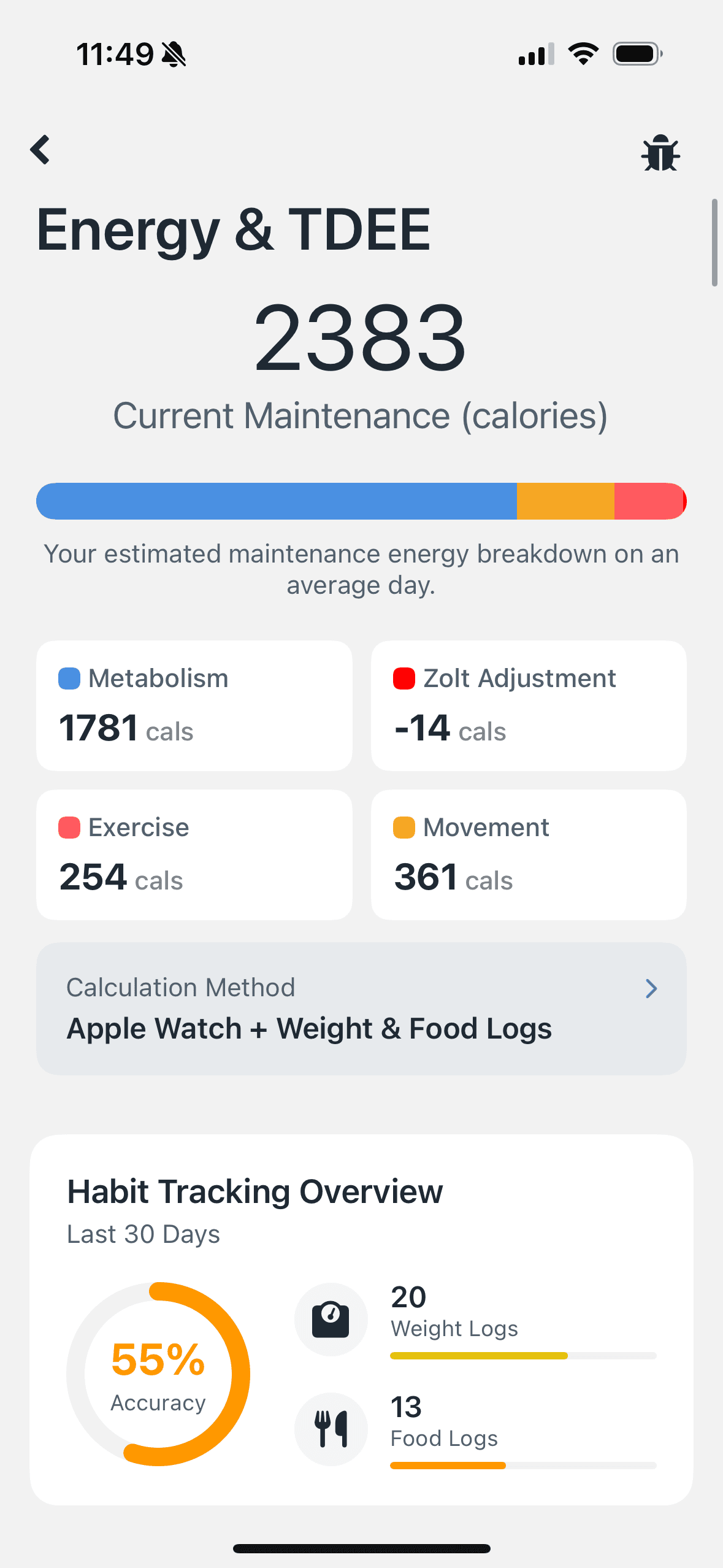
Total Daily Energy Expenditure (TDEE) is a fundamental concept in nutrition and fitness that represents the total number of calories your body burns in a 24-hour period. It's synonymous with "maintenance calories"—the amount you need to eat to maintain your current weight.
What Is TDEE?
TDEE represents your total daily energy expenditure measured in calories. Think of it like fuel for a car—your caloric needs vary based on body size, composition, and activities.
Standard TDEE Components
1. Basal Metabolic Rate (BMR)
BMR accounts for 60-70% of daily calorie burn. These are the calories your body needs for essential functions:
- Breathing and circulation
- Cell production and repair
- Nutrient processing
- Brain function
- Temperature regulation
BMR is influenced by body size, composition, age, sex, genetics, and hormonal factors. Common measurement methods include the Harris-Benedict formula and Mifflin-St Jeor equation.
2. Thermic Effect of Food (TEF)
TEF accounts for approximately 10% of TDEE—the energy required to digest, absorb, and process nutrients:
| Macronutrient | Thermic Effect | |---------------|----------------| | Protein | 20-30% | | Carbohydrates | 5-10% | | Fats | 0-3% |
This is why high-protein diets can slightly boost metabolism.
3. Non-Exercise Activity Thermogenesis (NEAT)
NEAT accounts for 15-50% for active individuals. This includes all movement that isn't structured exercise:
- Standing and sitting
- Fidgeting
- Walking around the house or office
- Typing and household chores
- Yard work and general movement
NEAT varies dramatically between individuals and is one of the biggest factors in why some people seem to "eat whatever they want" without gaining weight.
4. Exercise Activity Thermogenesis (EAT)
EAT includes intentional exercise:
- Gym workouts
- Running, swimming, cycling
- Sports and recreational activities
For athletes, EAT can account for 15-30% of TDEE.
5. Adaptive Thermogenesis
This accounts for:
- Temperature maintenance responses
- Metabolic adaptations to over/underfeeding
- Environmental adaptive responses
This is why your metabolism can slow down during extended dieting periods.
Zolt's TDEE Breakdown
Zolt simplifies the scientific model into four practical categories:
1. Basal Metabolic Rate
Uses validated equations refined by actual user data over time.
2. Non-Exercise Activity
Combines traditional NEAT + TEF. Uses Apple Watch movement data for accuracy.
3. Exercise Activity
Aligns with scientific EAT. Uses heart rate and movement data for precision.
4. Metabolic Adjustment
Accounts for individual variations, adaptive responses, hormonal factors, genetics, environmental effects, and measurement inconsistencies.
Why Zolt's Approach Is More Practical
Traditional scientific models have limitations outside laboratory settings:
- Measurement challenges – TEF and NEAT are nearly impossible to measure in daily life
- Category overlap – Is walking to work NEAT or exercise?
- Individual variability – Two people with identical stats can have vastly different metabolisms
Zolt addresses these by:
- Focusing on measurable metrics from your Apple Watch
- Simplifying categories for daily use
- Including metabolic adjustment for individual differences
- Using dynamic, data-driven updates
How Zolt Calculates Your TDEE
- Primary method: Analyzes your caloric intake vs. weight changes over time (the gold standard for accuracy)
- Enhanced breakdown: Allocates total TDEE across components using Apple Watch data
- Continuous refinement: Personalizes the algorithm with consistent logging
Learn more about adaptive TDEE and how it differs from static calculators.
Why Understanding TDEE Breakdown Matters
- Strategic adjustments: Low BMR percentage suggests muscle-building could boost metabolism
- Identifying opportunities: Small NEAT indicates potential for increased daily movement
- Realistic expectations: Understanding how much exercise actually contributes to total expenditure
The Bottom Line
TDEE is the foundation of weight management. To lose weight, eat below your TDEE. To gain weight, eat above it. To maintain, match it.
The challenge is knowing your true TDEE, which varies based on dozens of factors and changes over time. Static calculators give you a starting estimate. Adaptive TDEE tracking gives you your actual number, personalized to your body.