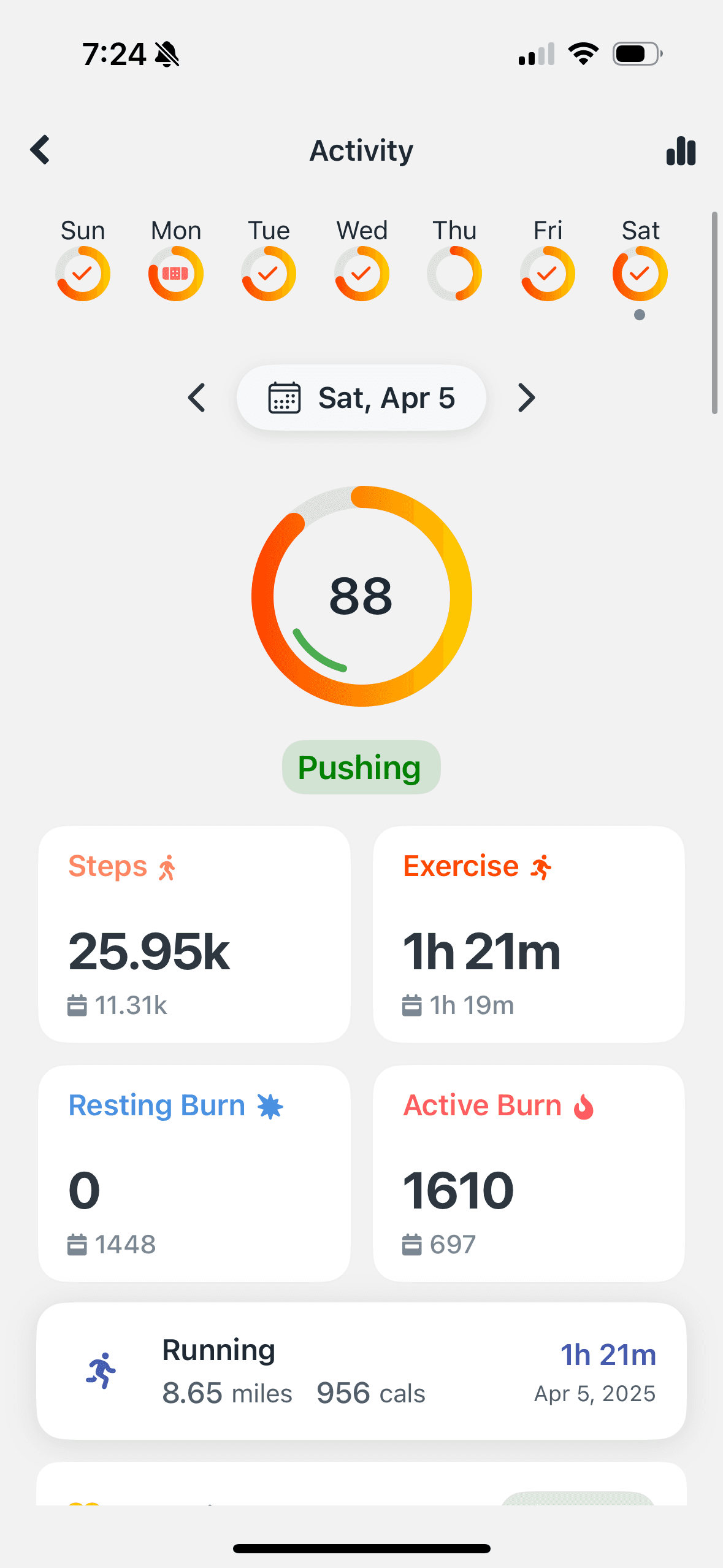
Zolt's Activity Score is a personalized daily measurement of your physical movement and exercise intensity. It analyzes your movement, workouts, heart rate data, and calorie expenditure to provide a comprehensive view of your daily physical activity levels.
Understanding Your Activity Score
| Rating | Score Range | What It Means | |--------|-------------|---------------| | Pushing | 100+ | You're exceeding high activity thresholds and pushing your physical limits | | High Energy | 75-100 | You're maintaining excellent activity levels that support fitness gains | | Active | 50-75 | You're meeting recommended activity guidelines for good health | | Balanced | 25-50 | You're maintaining moderate activity that supports basic health | | Recovery | 0-25 | Your activity level is minimal, which may be appropriate for rest days |
Note: Zolt takes about 30-60 days to fully calibrate to your personal movement patterns for the most accurate assessments.
How Zolt Calculates Your Activity Score
Your Activity Score is personalized by analyzing your movement patterns in relation to your own historical data, not just general population averages. Zolt learns what's normal for YOU over time, making the score increasingly accurate and relevant to your lifestyle.
The scoring system makes higher scores progressively more challenging to achieve. This reflects the physiological reality that fitness improvements follow a curve of diminishing returns—it takes proportionally more effort to move from "Active" to "High Energy" than from "Balanced" to "Active."
What Goes Into Your Activity Score
The Activity Score analyzes three key components:
- Everyday Movement – Your daily physical activity beyond structured workouts (walking, stair climbing, general movement)
- Structured Workouts – Your intentional exercise sessions, including duration, intensity, and type
- Activity Patterns – The consistency and timing of your movement throughout the day
Why Each Component Matters
Everyday Movement
Research shows that daily movement accounts for a significant portion of your total energy expenditure. Higher levels of everyday activity are associated with improved metabolic health, reduced cardiovascular risk, and better weight management. Even small increases in daily movement can contribute significantly to your overall health.
Research from Mayo Clinic has shown that prolonged sitting can reverse the benefits of even vigorous exercise, with a 35-40% increased health risk for those who sit for six or more hours daily, regardless of their exercise routine.
Structured Workouts
Dedicated exercise sessions provide unique benefits that casual movement cannot. Structured workouts that elevate your heart rate, challenge your muscles, or improve flexibility contribute to cardiovascular health, muscular strength, bone density, and mental wellbeing.
High-intensity interval training (HIIT) has been shown to improve cardiorespiratory fitness more effectively than moderate-intensity continuous training, even with less total exercise volume. The intensity of your workouts plays a crucial role in achieving specific fitness adaptations and health outcomes.
Activity Patterns
How you distribute activity throughout your day affects both your metabolic health and your recovery capacity. Consistent movement with appropriate recovery periods typically yields better health outcomes than long sedentary periods followed by intense exercise bursts.
Research indicates that moving every 60 minutes for even a couple of minutes can provide significant physical and mental health benefits, particularly at a cognitive level.
Actionable Insights Based on Your Score
Pushing (100+)
- What it means: You're significantly exceeding typical activity thresholds
- Perfect for: Peak training phases, special event preparation
- Actions: Ensure you're balancing this high activity with adequate recovery and nutrition
- Notes: While impressive, consistently maintaining this level may lead to overtraining without proper recovery strategies
High Energy (75-100)
- What it means: You're maintaining excellent activity levels that support fitness gains
- Perfect for: Active training periods, lifestyle enhancement
- Actions: Continue with your current activity level while monitoring recovery metrics
- Notes: This range represents an ideal target for those looking to improve fitness or maintain a highly active lifestyle
Active (50-75)
- What it means: You're meeting recommended activity guidelines for good health
- Perfect for: General health maintenance, moderate fitness goals
- Actions: Maintain this consistent activity level with a mix of different exercise types
- Notes: This range aligns with public health guidelines for physical activity and represents a sustainable level for most people
Balanced (25-50)
- What it means: You're maintaining moderate activity that supports basic health
- Perfect for: Busy days, active recovery, or beginners building habits
- Actions: Look for small opportunities to add movement throughout your day
- Notes: While not optimal for fitness gains, this level can maintain basic health and serves as a good foundation
Recovery (0-25)
- What it means: Your activity level is minimal, which may be appropriate for rest days
- Perfect for: Scheduled rest days, illness recovery, or after particularly intense efforts
- Actions: If this is a planned recovery day, focus on sleep, nutrition, and gentle movement
- Notes: Regular scores in this range may indicate opportunities to increase daily movement for better health
Daily Activity Targets
Zolt provides personalized daily activity targets to help guide your movement and exercise decisions. These targets are designed to help you consistently reach the "Active" score range (50-75) when you're in your normal training status.
How Recovery Affects Your Targets
Your Recovery Score directly influences your Activity targets through a dynamic relationship:
- Excellent Recovery (75-100) – Your activity targets remain at their standard levels or may even increase slightly, giving you the green light for more challenging workouts
- Good Recovery (50-75) – Standard target ranges apply, supporting your normal activity routine
- Fair Recovery (25-50) – Activity targets may be slightly reduced to accommodate your body's current recovery state
- Poor Recovery (0-25) – Activity targets are noticeably reduced to prioritize recovery while still encouraging basic movement
Tips for Improving Your Activity Score
- Prioritize consistency – Regular moderate activity throughout the week is better than occasional extreme efforts
- Mix activity types – Include both cardio and strength training for the most balanced approach
- Break up sedentary time – Short movement breaks throughout the day contribute significantly to your non-exercise movement
- Increase intensity strategically – Adding short bursts of higher-intensity effort can boost your score efficiently
- Balance activity with recovery – Alternate higher activity days with more moderate days for optimal results. Quality sleep is essential for muscle recovery, with research showing that growth hormone essential for tissue repair is produced primarily during deep sleep
- Track trends – Look for patterns in your activity score to identify what habits positively impact your movement
Remember, the goal isn't necessarily to maximize your score every day but to maintain a healthy activity pattern that fits your lifestyle and supports your health and fitness goals.
Frequently Asked Questions
Do I need to reach "Active" or "High Energy" levels every day?
No! Consistently alternating between "Active" and "High Energy" days with occasional "Balanced" days for recovery often represents an optimal pattern for most people. This aligns with the Zolt Scoring Philosophy.
Why did my score stay moderate even though I had an intense workout?
The Activity Score measures your total daily movement, not just structured exercise. A single intense workout combined with high sedentary time might result in a moderate overall score.
Can I still get a good score without formal exercise?
Yes! If you maintain high levels of non-exercise movement through consistent daily activities (taking the stairs, walking while on calls, gardening, active commuting, etc.), you can achieve "Active" range scores even without formal workouts. Studies have shown that non-exercise movement can account for up to 70% of your daily metabolic output.