One of the most common mistakes people make when starting a bulking phase is having unrealistic expectations about muscle growth. Despite what supplement companies and social media influencers might claim, natural muscle gain follows predictable patterns backed by scientific research.
Maximum Natural Muscle Gain Rates
Research by Alan Aragon and Lyle McDonald's comprehensive analysis of muscle growth rates have established clear guidelines for natural muscle gain potential.
Beginner Lifters (0-1 years of training)
Beginner lifters get to experience "newbie gains"—the highest rate of natural muscle growth one will ever experience. Visual changes and lifting progression is fast, and this is the point where most new lifters get "hooked" on lifting.
- Maximum muscle gain: Up to 2 pounds (0.9kg) per month
- Annual potential: 20-25 pounds (9-11kg) in the first year
Intermediate Lifters (1-5 years of training)
Intermediate lifters generally can still progress every week or two weeks, but the rate of muscle gain is now much slower. This phase requires much more strategic training and nutrition.
- Maximum muscle gain: Up to 1 pound (0.45kg) per month
- Annual potential: 10-12 pounds (4.5-5.4kg) in the second year, trending downwards to 3-6 pounds (1.4-2.7kg) per year
Advanced Lifters (5+ years of training)
At this stage, progress becomes increasingly difficult and is much slower. It requires meticulous attention to training and recovery to keep progressing.
- Maximum muscle gain: Up to 0.5 pounds (0.23kg) per month
- Annual potential: 1-6 pounds (0.45-2.7kg) per year
Key Factors Affecting Your Muscle Growth Potential
1. Genetics and Body Type
Your genetic makeup significantly influences your muscle-building potential through:
- Muscle fiber type distribution (fast-twitch vs. slow-twitch)
- Natural testosterone and growth hormone levels
- Muscle insertion points and skeletal frame
- Nutrient partitioning efficiency
According to research by Casey Butt, Ph.D., your wrist and ankle measurements can actually help predict your maximum muscular potential.
2. Age and Hormonal Status
Age plays a crucial role in muscle-building potential:
- Peak muscle-building years: 18-35
- Testosterone levels gradually decline by 1-2% per year after age 40
- Growth hormone production decreases with age
- Recovery capacity typically diminishes with age
Research published in the Journal of Applied Physiology shows that while older individuals can still build muscle, the rate is typically slower compared to younger adults.
3. Training History
Your training background affects future gains through:
- Previous athletic experience
- Movement pattern development
- Neuromuscular efficiency
- Existing muscle memory
Studies show that muscle memory through epigenetic mechanisms can help previously trained individuals regain muscle mass more quickly than first-time trainers.
4. Recovery Capacity
Your ability to recover between workouts matters for muscle growth. You should be sleeping enough with high quality, managing stress well, and staying on top of your diet. Check your sleep score and recovery score to optimize this.
Being Realistic About Bulking Goals
These numbers represent maximum potential gains under optimal conditions.
The Truth: Most people should expect to gain 60-70% of these maximum rates while minimizing fat gain during a proper bulk.
This means you're probably not gaining 0.5 lbs of muscle a week every week. Rather, based on your sleep, recovery, genetics, and other factors, you'll gain 0.2 lbs one week, 0.4 lbs another week, 0.08 lbs the next, etc. Muscle gain is not a linear process.
The best proxy is simply: if your lift numbers in the gym are going up over time, there's a good chance you're gaining appreciable amounts of muscle mass.
Important: The maximum muscle gain numbers are not equal to the amount of actual bodyweight one puts on per month. If you put on 1 pound of muscle in a month, you probably gained ~2 pounds of total bodyweight, which includes water weight, body fat, and other common fluctuations.
Creating Your Personal Bulking Timeline
Successful bulking requires adequate time for your body to build new muscle tissue.
- Minimum: 3-4 months to see meaningful muscle growth and strength gains
- Sweet spot: 4-6 month bulking phase for most lifters
- Advanced: 6-12 months for late-intermediate to advanced lifters
During longer bulks, implementing strategic maintenance phases every 8-12 weeks helps prevent fat accumulation. These maintenance phases typically last 2-3 weeks.
Setting Weekly Targets
To maximize muscle gain while minimizing fat gain, aim for a weight increase of 0.5-1% of your body weight per month.
For a 180-pound lifter, this means:
- Monthly target: 0.9-1.8 pounds
- Weekly target: 0.4-0.5 pounds
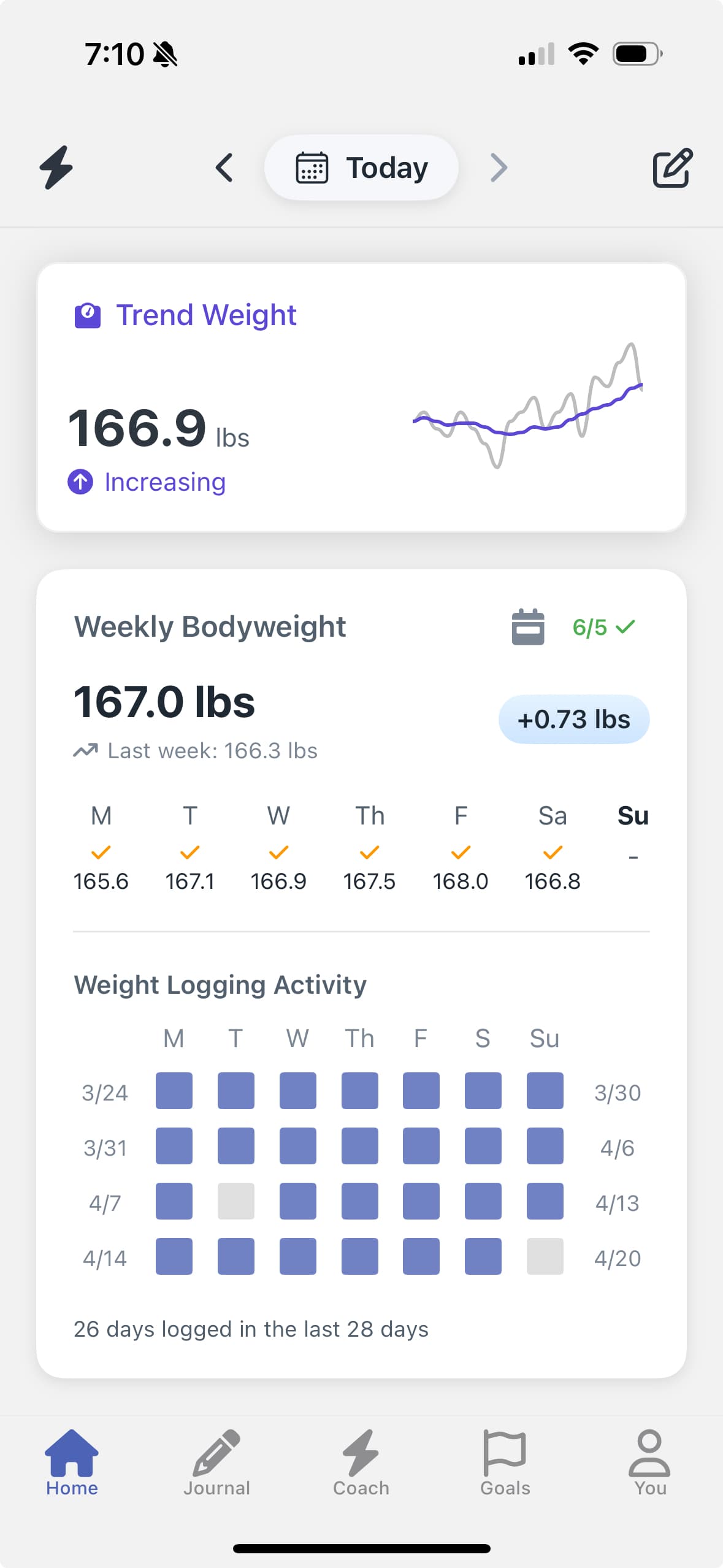
Scale weight can fluctuate significantly due to water, food, and sodium intake, so focus on the weekly average rather than daily numbers. Zolt makes this easy by automatically calculating your Trend Weight over time.
Zolt's bulk coaching feature automatically sets and adjusts your calorie targets over time as you continue bulking, ensuring your weekly weight gain is at a consistent, optimal level for maximum muscle gain.
The Bottom Line
Natural muscle building takes time and patience. Set realistic expectations based on your training experience:
- Beginners: Up to 2 lbs/month
- Intermediates: Up to 1 lb/month
- Advanced: Up to 0.5 lbs/month
Focus on progressive overload, adequate protein, quality sleep, and consistency. Track your trend weight and lift numbers over time rather than obsessing over daily scale fluctuations.